

The car world has changed fast. Gas prices go up and down, people care more about the planet, and suddenly electric cars aren’t “future tech” anymore—they’re everywhere. If you’re a daily commuter (or dreaming about your first car), hybrids and plug-in hybrids (PHEVs) are two of the coolest options. Both mix gas and electric power, but they’re built for very different driving styles. Picking the right one is like choosing between sneakers and running shoes—it depends on how you move every day.
Understanding Hybrid Technology: The Basics
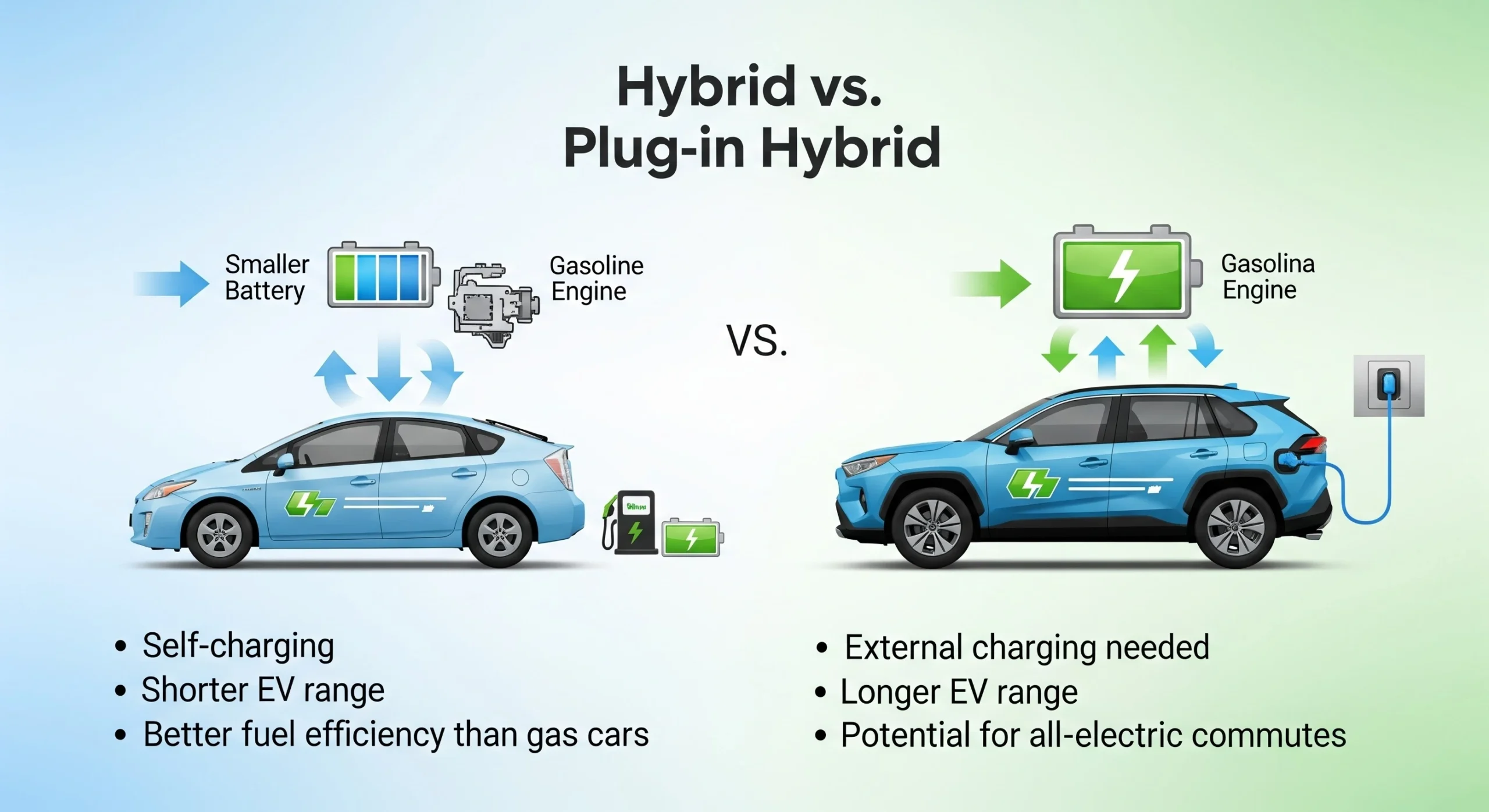
Traditional hybrids are the “easy mode” of electric cars. You don’t plug them in. Ever. They charge themselves while you drive, using energy from braking and the gas engine. It’s like your phone magically charging while you scroll TikTok—no cables needed.
They use a small battery (about the size of a large backpack), but it’s super smart. In city driving, the electric motor does most of the work, which saves fuel and feels smooth and quiet. On the highway, the gas engine steps in like a teammate tagging you out.
Cars like the Toyota Prius or Honda Accord Hybrid are famous for this. They’re reliable, sip fuel like it’s expensive juice, and can get around 45–55 miles per gallon. Not flashy, but incredibly clever—like the straight-A student who also knows how to have fun.
- Read Also: Top Affordable EVs for the US Market in 2026
- Read Also: The State of Public Charging: A Cross-Country Reality Check
What Makes PHEVs Different?
Plug-in hybrids are like hybrids that went to the gym and leveled up. The big difference? You plug them in. That bigger battery means you can drive on pure electricity for real distances before the gas engine even wakes up.
Most PHEVs can go about 20–50 miles using only electric power. That’s enough for school, practice, hanging out with friends, and back home—without burning a single drop of gas. When the battery runs out, no stress. The car just switches to hybrid mode and keeps going like nothing happened.
Charging is easy. You can plug into a normal wall outlet at home, or use a faster charger to fill up overnight. It’s kind of like charging a giant phone… except this phone can take you on a road trip.
Cars like the Toyota RAV4 Prime or Jeep Wrangler 4xe are great examples. They let you feel like you’re driving an electric car during the week, but still have gas power ready for long trips. Best of both worlds—no range anxiety, just freedom.
Cost Comparison: Initial Investment and Long-Term Savings
Let’s talk money—because even cool cars have to make sense for your wallet (or your parents’). Hybrids and PHEVs don’t just differ in tech, they hit your bank account differently too. The trick is looking past the price tag and thinking long-term, like a chess player, not a checkers one.
Upfront Purchase Price
PHEVs usually cost more at first—about $5,000 to $10,000 extra. Bigger battery, fancier tech, higher price. It’s like buying the pro version of a game console.
But here’s the plot twist: the government may literally pay you back. PHEVs can qualify for tax credits up to $7,500, plus extra perks in some states. Regular hybrids? No such luck. Suddenly, that big price gap shrinks fast.
Fuel and Energy Costs
This is where PHEVs can feel like a cheat code. If your daily drive fits inside the electric range, you’re paying pennies to drive. Electricity is way cheaper than gas—think $0.04 per mile vs. triple that on gas.
Drive about 30 miles a day on electric? You could save $1,500–$2,000 a year. But if you can’t charge easily or drive way more than the battery range, a normal hybrid might be the smarter move.
Maintenance and Insurance
Both are easier on maintenance than old-school gas cars—brakes last longer, engines work less. PHEVs can cost a bit more to insure because they’re pricier, but battery warranties are solid (8–10 years). And battery replacements? Rare, not the horror story people think.
Environmental Impact: Going Green with Your Commute
If saving the planet is on your vibe list, both hybrids and PHEVs are way better than old-school gas cars—but they don’t help the Earth in the same way.
Regular hybrids already make a big difference. They cut pollution by about 25–35% just by being smarter with fuel and shutting the engine off when you’re stopped. It’s like turning off the lights when you leave a room—simple, but it adds up.
PHEVs can be even greener if you actually plug them in. Drive mostly on electricity and you can slash tailpipe pollution by up to 60–80%. That’s huge. In places with clean power like solar or wind, PHEVs are basically eco-heroes. Even in areas that still use coal, studies show PHEVs usually pollute less than regular hybrids over time.
And here’s the cool part: as electricity gets cleaner every year, PHEVs just keep getting better for the planet—without you changing a thing. That’s like leveling up automatically.
Real-World Commute Scenarios: Which Technology Fits Your Lifestyle?
Choosing between a hybrid and a PHEV isn’t about what sounds cooler—it’s about how you actually live. Think of it like picking a character in a game. The best one depends on your play style, not just their stats.
The Short Commuter (Under 30 Miles Daily)
If your daily drive is under 30 miles and you can charge at home or school, a PHEV is basically cheating—in a good way. You’ll drive almost entirely on electricity and might forget what a gas station even looks like. Cars like the RAV4 Prime can go weeks on one tank. That’s wild.
The Long Commuter (50+ Miles Daily)
If you’re driving a lot every single day, a regular hybrid makes more sense. No plugging in, no planning—just great gas mileage all the time. Something like a Camry Hybrid just works. A PHEV would still help at first, but once the battery runs out, it’s just a heavier hybrid.
The Weekend Warrior
Short drives during the week, epic road trips on the weekend? PHEVs are perfect for that life. You cruise on electric power Monday through Friday, then hit the highway without worrying about chargers or range on Saturday. Best of both worlds.
Apartment Dwellers and Street Parkers
No place to charge? Then a PHEV loses its superpower. In this case, a normal hybrid is the real MVP—efficient, simple, and zero charging stress. Just get in and go.
Performance and Driving Experience
Let’s talk about how these cars feel, because numbers are cool, but vibes matter. PHEVs are the fun ones. Step on the pedal and—boom—instant power. Electric motors don’t wait to wake up, so many PHEVs hit 0–60 super fast, like sports-car fast. It’s the kind of acceleration that makes your friends go, “Whoa.”
Regular hybrids are more chill. They’re not trying to race anyone, but they’re smooth, calm, and easy to drive—especially in traffic. In the city, they glide quietly using electric assist, which feels kind of futuristic, like you’re floating.
Both are way quieter than normal gas cars, but PHEVs stay silent longer because they run on electricity more often. Short trips in a PHEV can feel like driving an electric car full-time—and once you get used to that silence, it’s hard to go back.
- Read Also: Home EV Charging 101: Costs and Installation in the US
- Read Also: What Happens to Old EV Batteries? The Future of US Recycling
Making Your Decision: Key Considerations
Before choosing sides, pause and think about your real life—not the commercials.
- How far do you drive every day? If it fits inside a PHEV’s electric range, that’s a big win.
- Can you charge easily at home, school, or work? No charger = no PHEV magic.
- Is electricity cheap where you live compared to gas? That can totally flip the math.
- Are there tax credits or incentives? Free money changes everything.
- Are you keeping the car long-term? That’s how you make back the higher upfront cost.
Conclusion: The Right Choice for Your Commute
Here’s the real talk: there’s no “best” car for everyone—only the best car for you. Hybrids and PHEVs are like two smart paths to the same goal: saving money, using less gas, and being nicer to the planet.
Regular hybrids are the no-drama choice. They’re cheaper upfront, super reliable, and don’t ask you to change your routine. Just drive, save fuel, repeat.
PHEVs are the power move if you can charge easily and don’t drive far every day. You get electric driving for daily trips and gas backup for road trips—zero stress, lots of flexibility.